
Understanding Programming Logic and System Design
Developers typically become comfortable with syntax first, while structural thinking develops much later.
That gap is rarely visible in small systems. A few functions, a straightforward SQL query, and a single REST endpoint are often sufficient to deliver working features. At that scale, everything still fits neatly together, and the system advances without forcing deeper architectural decisions.
The friction emerges as systems scale. Logic inevitably spreads across API routing, background task workers, database transactions, and scheduled ETL jobs. Small assumptions made early in development begin to interact in unexpected ways. A validation rule added for one endpoint breaks an entirely different asynchronous workflow. A temporary workaround hardens into core system behaviour. Eventually, the codebase becomes difficult to reason about, even for the original authors.
Programming logic and system design is the discipline of structuring software so its behaviour remains predictable as operational complexity scales. It focuses on problem analysis, decision modelling, data flow, and the organization of software into maintainable, isolated components. Languages and frameworks evolve, but the underlying engineering challenges remain constant.
Logic Precedes Implementation
Implementation is the final stage of a much broader analytical process. Before writing a single line of code, engineers must determine:
The exact operational responsibilities of the system
The data flow and state dependencies
The conditional evaluation of business rules
The secure-by-default handling of failures
The contract boundaries between components
The systemic constraints that must remain invariant
A high percentage of production defects are entirely disconnected from syntax. They stem from incorrect assumptions, incomplete requirements, poorly modelled state transitions, and hidden dependencies. The programming language merely exposes these logical flaws at runtime.

Defining the Problem Space
System design starts by eliminating ambiguity at the requirements stage. Business workflows are frequently vague or contradictory. Different operational units often describe identical processes differently based on their specific interactions with the system.
Consider a standard enterprise app: one department considers a record "approved" upon managerial sign-off, while another considers it "approved" only after an ETL pipeline completes financial reconciliation. If this state model is not strictly defined upfront, developers will implement conflicting logic paths throughout the codebase.
Establishing a solid architectural foundation requires defining:
System boundaries and domain ownership
Actor permissions and responsibilities
Strict inputs, outputs, and validation rules
Expected operational workflows
Clear failure and degradation conditions
Without this rigor, even the cleanest code will degrade into an unstable system.
Core Logic Structures
Despite the massive scale of modern distributed systems, application logic relies on three foundational control structures:
Sequence: The explicit order of execution.
Selection: Decision-making and conditional evaluation.
Iteration: Repeated execution over data sets or state changes.
Real-world complexity arises from combining these structures across the multiple layers of an enterprise application. An incoming REST API request validates payload data, a service layer evaluates business rules, a database transaction attempts a state mutation, and an asynchronous worker queues downstream notifications.
Each boundary crossed introduces distinct execution paths and potential state transitions. When these paths are not explicitly modelled, the system becomes unpredictable under concurrency or infrastructure stress.
Separation of Concerns and Decomposition
Large codebases become unmaintainable when responsibilities blur. Tight coupling frequently manifests as business logic leaking into unexpected layers: ORM models, API serializers, middleware, or scheduled scripts.
Initially, this lack of boundary enforcement accelerates feature delivery. Over time, identical logic appears in disparate locations with slight behavioral variations, destroying data consistency.
Decomposition mitigates this by splitting systems into isolated units with single responsibilities. This practice relies heavily on the Separation of Concerns (SoC), enforcing clear boundaries:
Isolating API routing from core business logic
Abstracting database access from validation rules
Decoupling infrastructure constraints (like Docker configuration) from application code
Separating read-heavy workflows from write-heavy transactional paths
Effective decomposition drastically improves maintainability, unit test isolation, and operational visibility.
Data Design Dictates System Complexity
Many architectural bottlenecks are fundamentally data modeling failures disguised as application bugs. When a poor relational or document model is deployed, the application layer is forced to compensate with heavy, repetitive logic:
Redundant data transformations
Aggressive, defensive input validation
Complex state handling to mask schema deficiencies
Data modeling dictates application architecture. Robust data design requires strict attention to entity relationships, lifecycle management, transactional boundaries, and clear ownership of state mutations. Codebases lacking clear data ownership inevitably spawn concurrency bugs that only surface under heavy production load.
Control Flow and State Management
Control flow maps how execution traverses a system. In a monolithic, synchronous application, this path is relatively linear. In distributed enterprise systems, execution paths are highly fragmented.
A standard operational flow often involves a FastAPI request triggering validation, committing a PostgreSQL transaction, and publishing a message to a broker for downstream consumption. While the business objective is singular, the underlying execution relies on multiple, independent paths.
This fragmentation is what makes asynchronous architectures challenging to debug. Strong system design makes these execution paths explicit, auditable, and traceable, rather than relying on implied interactions.
Abstraction and Encapsulation
Abstraction reduces cognitive load by masking implementation details behind stable interfaces. Encapsulation protects internal state by restricting direct access. These concepts are heavily utilized to reduce code duplication (DRY) and isolate change impact.
However, over-abstraction is a persistent hazard in enterprise environments. Teams often engineer complex layers to accommodate hypothetical future requirements, ignoring the YAGNI (You Aren't Gonna Need It) principle. This approach results in deep architectural layering, excessive indirection, and brittle interfaces.
Keeping it simple (KISS) often yields better results. Abstraction is most effective when introduced to solve immediate system friction, rather than to satisfy theoretical design patterns.
Error Handling as Architecture
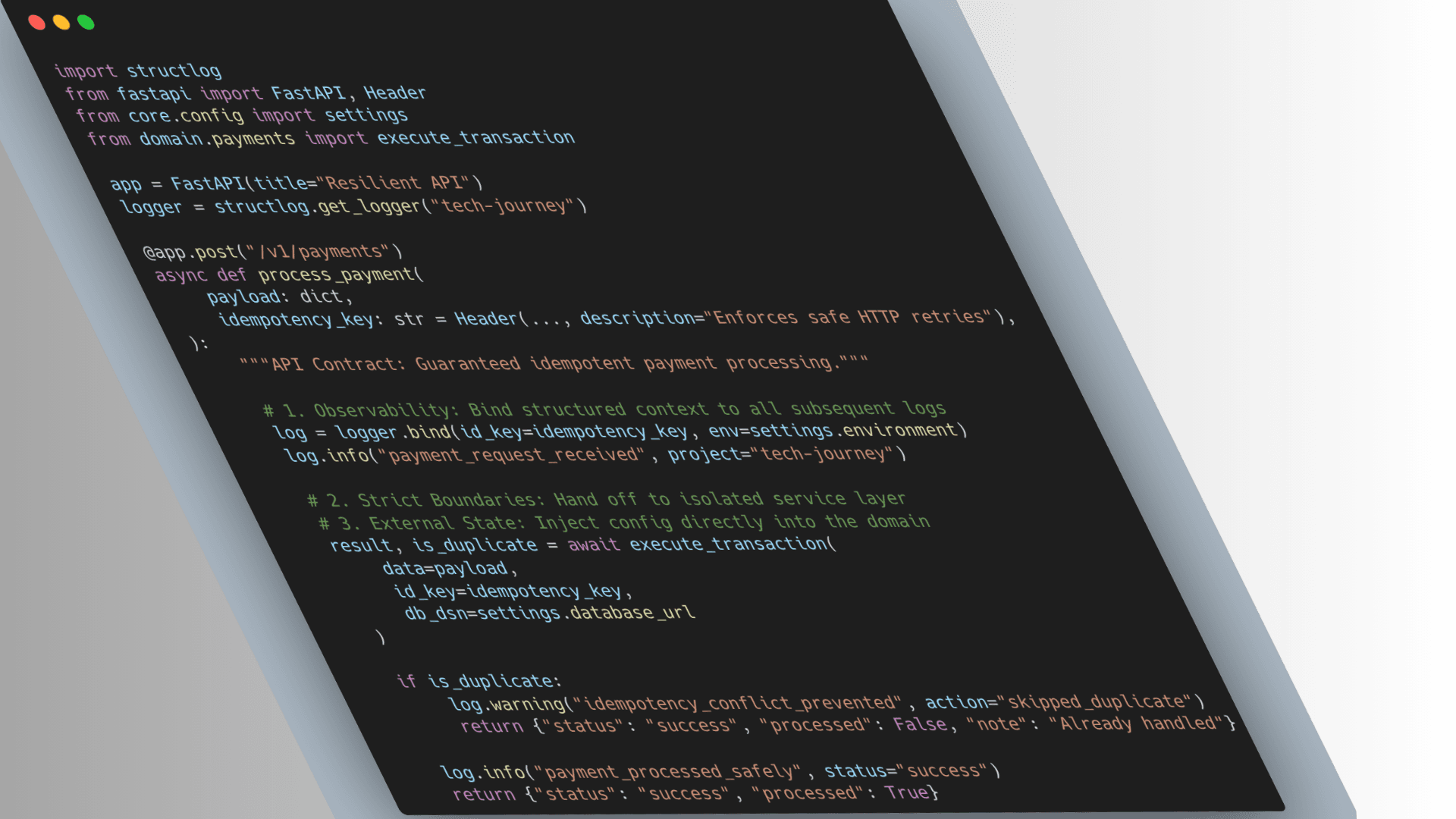
Error handling is not a secondary implementation detail; it is a core architectural pillar. A production-grade system requires a defined strategy for handling faults securely and predictably. Engineers must explicitly design for:
Identifying which operations are safe to retry
Defining strict database rollback conditions
Establishing standardized logging and observability formatting
Ensuring system degradation fails securely, rather than exposing internal state
Inconsistent fault tolerance across microservices destroys operational stability. If one service retries indefinitely, another drops the payload immediately, and a third silently swallows the exception, the aggregate system behavior becomes entirely unpredictable.
Testability as a Structural Metric
Testing goes beyond quality assurance; it acts as a mirror for architectural health. Code that is notoriously difficult to test usually suffers from deep structural flaws:
Hidden external dependencies
Tightly coupled infrastructure components
Implicit, undocumented state transitions
Blurred domain boundaries
A well-architected system naturally produces isolated behavioral units, predictable data outputs, and explicit failure triggers. Experienced engineers prioritize testability primarily as a measurement of clean system design.
Conceptual Models Versus Engineering Reality
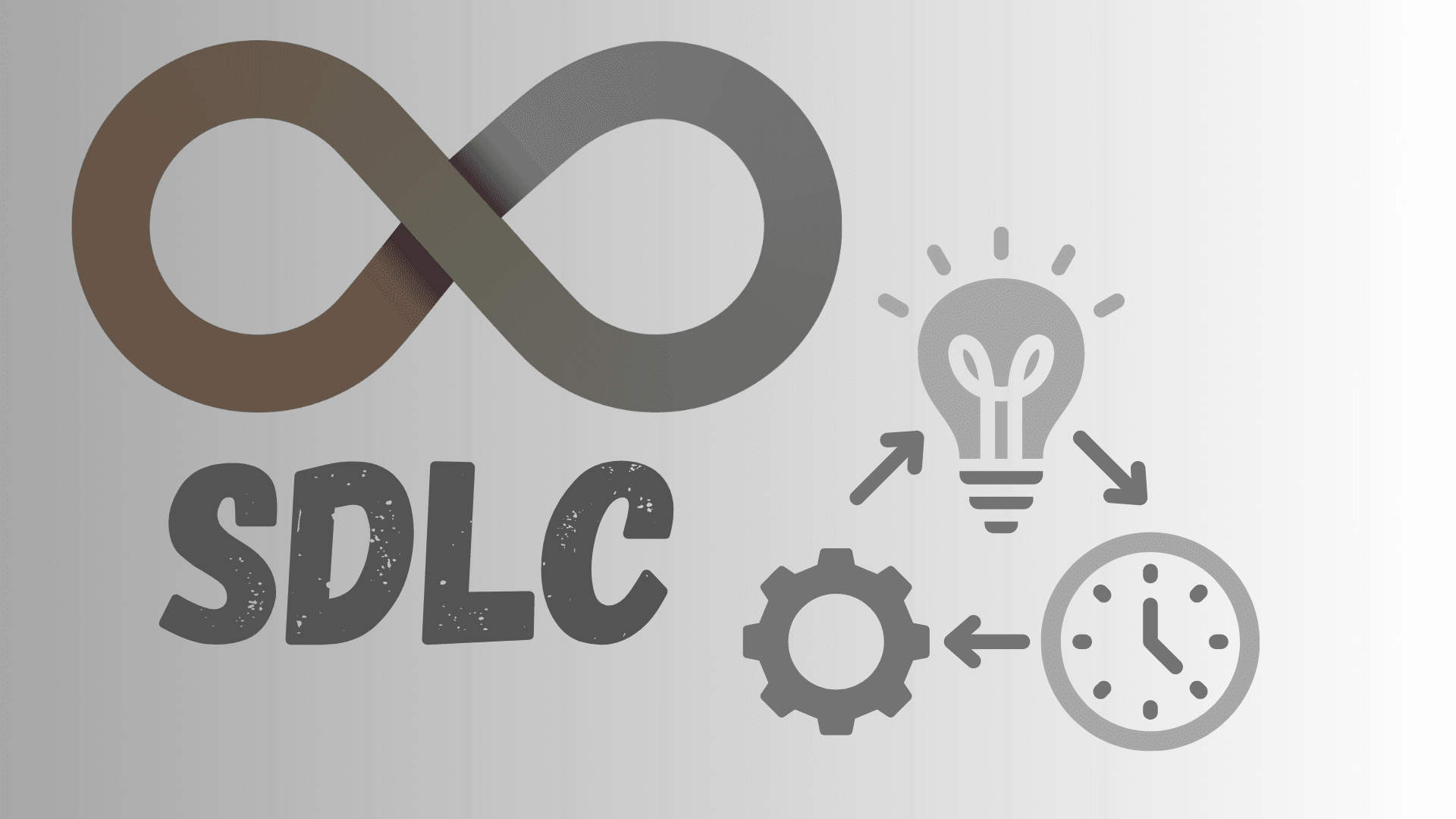
Academic models of programming logic often present a clean, linear progression: define the problem, analyze, design, implement, test, and deploy.
In real-world engineering environments, this process is highly iterative and fluid. Requirements shift mid-implementation. Security constraints necessitate immediate redesigns. Production incidents dictate architectural pivots.
The goal of software design principles is not to force a perfect, rigid model onto a chaotic reality. The objective is to manage complexity, define predictable boundaries, and ensure that the codebase remains adaptable, secure, and maintainable long after the initial deployment.